
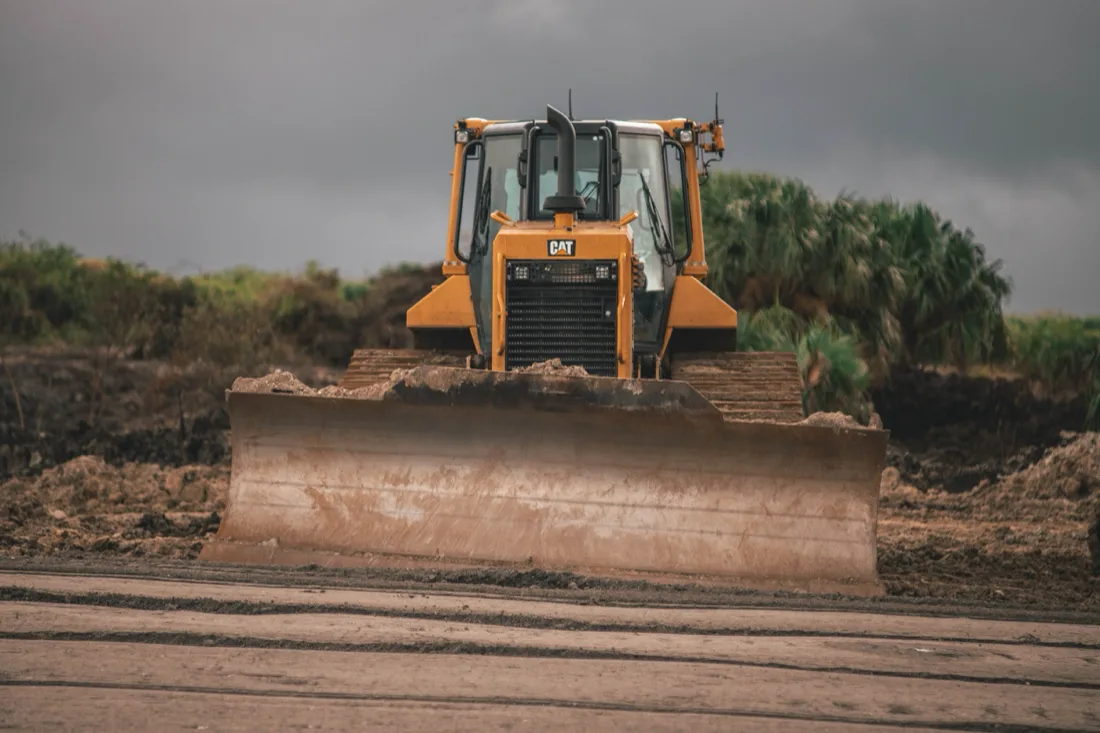
How to prepare a lot for building in Baldwin County, Alabama
Preparing a lot to build in Baldwin County runs in a set order: clear the vegetation, grub out the stumps and roots, rough grade the site, solve drainage, build and compact the pad, then cut in the driveway. On the Gulf Coast, drainage and permitting carry more weight than they do most places, because the ground is wet, sandy, and heavily regulated. Get the sequence right and the foundation goes in clean.
The site-prep sequence, start to finish
Site work is the part of a build nobody sees and everybody pays for later if it is done wrong. The order matters, because each step sets up the next. Here is the run for a typical Baldwin County homesite:
- Clear the trees and brush off the building envelope.
- Grub out the stumps, roots, and organic matter.
- Rough grade to shape the site and set the fall for water.
- Solve drainage with swales, fill, and pipe where the lot needs it.
- Build the pad and compact it to hold the foundation.
- Cut in the driveway and stabilize the access.
Most of this is grading and dirt work, and it is worth doing once, correctly, before a foundation crew ever shows up. Skip a step and you pay for it in a cracked slab or a yard that ponds after every storm.
Clearing and grubbing: getting down to dirt
Start by clearing the building envelope, not the whole parcel. On wooded coastal lots you are usually cutting loblolly and longleaf pine, water oak, sweetgum, and a thick understory of yaupon, wax myrtle, and saw palmetto. Many owners clear the pad and driveway traditionally and forestry mulch the rest, which keeps the wooded feel and the cost down.
Grubbing comes next, and it is the step people skip at their peril. Grubbing pulls the stumps, roots, and organic matter out of the pad area. If that material stays in the ground it rots and settles, and a slab poured over it cracks within a few years. For a foundation you want clean, mineral dirt with the organic layer stripped off and hauled clear.
Grading and drainage on a rainy coastal lot
This is the step that makes or breaks a Gulf Coast build. Mobile and Baldwin County get around 67 inches of rain a year, some of the heaviest in the country, and a lot of the ground is flatwoods sitting on a high water table. Water has to have somewhere to go, or it goes under your house.
Rough grading shapes the lot so every surface falls away from where the foundation will sit. On the coast that often means bringing in clean fill to raise the pad above the surrounding grade and the flood elevation. Sandy soil drains fast but erodes and ruts, while the clay flatwoods to the north hold water and swell, so the fix depends on which one you are standing on. From there, drainage does the real work: graded swales to carry runoff to the road or a ditch, French drains where water sits, and culverts under the driveway so you are not damming your own lot. Alabama’s stormwater rules also call for erosion and sediment control, like silt fence, on sites of an acre or more while the ground is open. On low lots, the drainage plan sometimes has to come before anything else.
Building the pad and cutting the driveway
Once the lot drains, the pad gets built and compacted. Clean fill goes down in lifts, each one compacted to a target density so the ground will not settle under the slab. This is excavation and dirt work done to a number, not by eye, and on wet coastal ground it is the difference between a foundation that sits still and one that moves. A good pad is built a few inches proud of grade and shaped so water runs off it.
The driveway comes last, once the heavy equipment is done chewing up the ground. Cutting it in early just means rebuilding it after the concrete trucks and framers have rutted it. Whether you go gravel or concrete, the driveway needs the same thing the pad does: a compacted base and a culvert where it crosses the ditch line. Our guide to gravel vs. concrete driveways on the coast breaks down which fits your lot.
Permits and land disturbance rules in Baldwin County
Site prep is regulated here, and the rules change with the parcel. Plan to confirm all of this before any equipment rolls.
Any job that disturbs one acre or more needs coverage under Alabama’s ADEM construction stormwater permit, which means an erosion and sediment control plan certified by a qualified professional and a notice filed with the state. In unincorporated Baldwin County, the county permits land-disturbing work, and lots in flood-prone areas fall under a separate land disturbance ordinance. Inside the cities it is stricter. Daphne requires a land disturbance permit once you clear more than 1,000 square feet, along with a posted permit sign and bare soil stabilized within about two weeks. Fairhope runs its own tree ordinance and permits tree removal through public works. Because the rules shift street to street, we check your parcel with the county or city up front so nothing stops the job mid-build.
FAQ
What is the first step in preparing a lot to build? Clearing the building envelope, then grubbing the stumps and roots out of the pad area. You want clean, mineral soil with the organic layer stripped off before any grading or fill goes down, because leftover roots and organic matter rot and settle under a slab.
Do I need a permit to clear and grade my lot in Baldwin County? Often, yes. Disturbing one acre or more triggers Alabama’s ADEM stormwater permit. Daphne requires a land disturbance permit over 1,000 square feet, and the county regulates land disturbance in unincorporated and flood-prone areas. Rules vary by city, so confirm before you start.
Why is drainage such a big deal on coastal Alabama lots? Because the area gets around 67 inches of rain a year and sits on sandy, flat, high-water-table ground. Without graded swales, fill, and drains carrying water away, runoff collects against the foundation and causes settling and cracks. Drainage is planned before the pad, not after.
How long does site prep take for a house lot? For a typical homesite, a few days to a couple of weeks, depending on how wooded and wet the lot is and whether fill has to be trucked in. Permitting and a wet forecast can stretch it, which is why the drier months move faster.
Can one contractor handle clearing through pad and driveway? Yes, and it is the cleaner way to do it. Running clearing, grubbing, grading, drainage, the pad, and the driveway under one crew keeps the sequence tight and the responsibility in one place. That is the site work EMCO Builders does across Baldwin and Mobile County.
Ready to break ground?
Good site prep is the cheapest insurance a build ever buys, and it is a lot harder to fix after the slab is poured. EMCO Builders handles clearing, grading, drainage, and pad work across Baldwin County, Mobile County, and South Alabama, with more than 30 years in this ground and Alabama Home Builder License #13967. Call (251) 747-7839 for a free look at your lot and a written estimate.